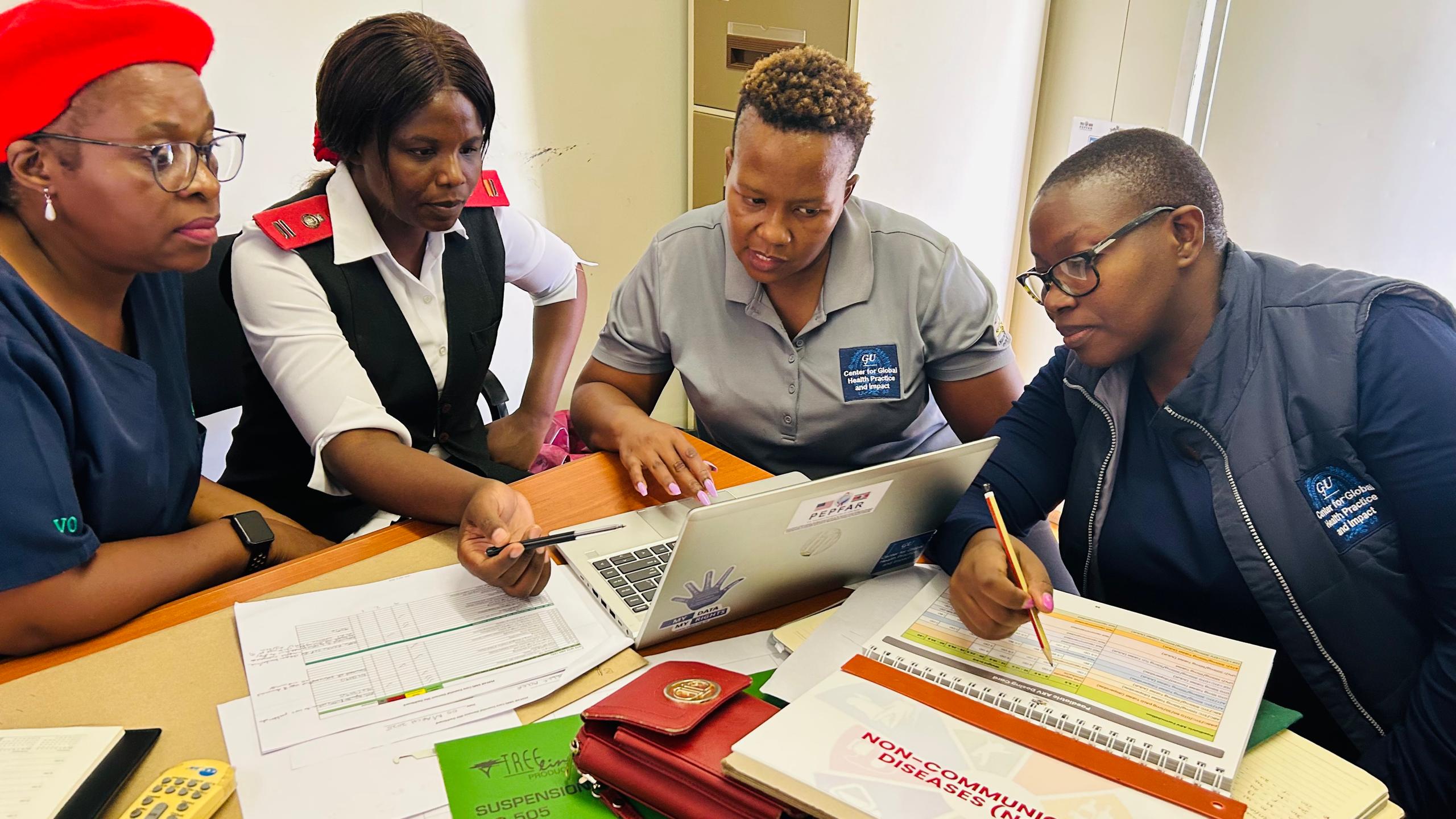
In 2025, the Georgetown University Center for Global Health Practice and Impact expanded its research portfolio to address critical challenges in HIV care, infectious diseases, and health system performance. Working alongside public health leaders across diverse contexts, our teams generated and applied evidence to improve service delivery and patient outcomes.
As a global implementation partner, CGHPI operates at the intersection of research and practice—ensuring that insights from real-world settings inform scalable, sustainable solutions. Increasingly, this work leverages data, digital tools, and artificial intelligence to support more informed decision-making and responsive care delivery.
Looking ahead, CGHPI will continue to deepen its research and partnerships, with a growing focus on applying global insights to strengthen health systems and improve outcomes in the United States.
The highlights below reflect the breadth of this work in 2025—from research outputs and geographic reach to the approaches shaping our impact.
2025 At A Glance
Our Research Approaches
- Epidemiology & Data Science – Generating actionable insights from complex data
- Implementation Science – Translating evidence into scalable solutions
- Behavioral Science – Understanding and influencing health behaviors
- Health Services Outcomes – Evaluating the effectiveness, quality, and impact of healthcare interventions
Our Publications
Researchers contributed to 9 peer-reviewed studies, advancing knowledge in infectious disease threats, system resilience, and equitable access to care.
Our Global Reach
Research spanned global, regional (Africa, Gulf Cooperation Council countries), and country-level contexts—including Uganda, Rwanda, Nigeria, and Eswatini—reflecting a breadth of health systems and implementation environments.
Research In Action
CGHPI’s research bridges evidence and practice, generating practical solutions to improve HIV care and care delivery systems. The following studies highlight how this work is addressing key challenges and informing scalable approaches across diverse contexts.
Leveraging Digital Tools to Strengthen HIV Outcomes
Research led by Armel Fosso Setubi, a Ph.D. candidate in Georgetown University’s Global Infectious Disease program, examines how electronic adherence monitoring technologies can improve HIV treatment outcomes in resource-limited settings. The study explores drivers of adherence, virologic failure, and drug resistance, demonstrating how digital tools can support more consistent treatment.
These findings point to the potential of technology-enabled approaches to enhance continuity of care and inform more patient-centered HIV programs.
Addressing the Dual Burden of Tuberculosis and Elevated Blood Glucose
A study co-authored by Dr. Samson Malwa Haumba, country resident director for Eswatini, investigates how elevated blood glucose—including undiagnosed diabetes—affects tuberculosis treatment outcomes. The findings reveal increased risk of poor outcomes, underscoring the growing intersection of infectious and noncommunicable diseases.
By identifying gaps in integrated care, this work highlights opportunities to strengthen screening, coordination, and patient management—approaches increasingly relevant for addressing complex patient needs.
Driving Innovation Through Global Engagement
Beyond generating evidence, CGHPI actively contributes to global dialogue by sharing research and implementation insights with the broader global health community.
Throughout 2025, researchers participated in 13 major conferences and convenings, presenting work on HIV care delivery, digital health, tuberculosis detection, and community-centered prevention strategies.
Advancing AI-Driven Solutions at CUGH 2025
At the Consortium of Universities for Global Health Conference, Dr. Katherine Robsky —assistant professor in the Division of Internal Medicine and lead for epidemiology, surveillance, and data science at CGHPI—chaired a pre-conference session on the role of technology and artificial intelligence in global health, convening leaders from over 60 countries.
The session highlighted a range of innovations demonstrating how AI can support diagnosis, drug development, and health system efficiency. Among the ten featured innovations, CGHPI contributed the Jara Wellness Assistant, presented by Dr. Ibrahim Bola Gobir, field director for West and Central Africa at CGHPI and CEO of Georgetown Global Health Nigeria.
This WhatsApp-based platform delivers personalized health information and was initially developed to support HIV and tuberculosis care in Nigeria. It has since expanded to additional countries and now addresses a broader range of health needs.
These efforts underscore how digital innovation can enable more responsive, scalable, and patient-centered approaches to care delivery across diverse settings.
Building Capacity for Sustainable Impact
Strengthening the systems and skills needed to translate research into practice is central to CGHPI’s approach. Through collaboration, mentorship, and applied learning, the Center supports partners in developing the capacity to implement and sustain effective solutions.
These efforts are reflected in both ongoing research initiatives and knowledge-sharing activities that advance practical, scalable approaches to care.
Strengthening Patient Engagement in HIV Care
As part of this work, CGHPI is advancing research to improve engagement in HIV care by identifying individuals at risk of treatment interruption and tailoring support accordingly.
Led by Steve Kretschmer, CGHPI’s human-centered design team lead, and supported by the Bill & Melinda Gates Foundation, this initiative includes strengthening national data systems such as TIER.Net, South Africa’s HIV care platform. The work integrates clinical and social-behavioral insights to better understand patterns of patient disengagement.
Findings are being translated into practical tools for frontline health workers, enabling more targeted interventions to improve retention and adherence.
Advancing Equity Through Community-Engaged Research
CGHPI also advances equity-centered approaches through partnerships with community leaders and organizations.
In a recent capacity building session, Martha Cameron, executive director of The International Community of Women Living with HIV – North America, highlighted the importance of the Meaningful Involvement of People Living with HIV framework in strengthening research and program design.
By embedding community perspectives throughout the research process—from design to dissemination—these approaches enhance relevance, build trust, and improve the effectiveness of health programs.
Expanding Global and U.S. Impact in 2026
In 2026, CGHPI will continue to expand its research, partnerships, and technical assistance efforts across both global and U.S. health systems—advancing locally driven approaches to improve HIV outcomes and support long-term sustainability.
This work will include supporting national efforts in the United States through the Health Resources and Services Administration’s Ending the HIV Epidemic initiative, where CGHPI serves as a Technical Assistance Provider. In this role, the Center supports jurisdictions in implementing innovative strategies to strengthen linkage to care, retention, and viral suppression.
Globally, CGHPI will continue advancing initiatives such as SUSTAIN, a multi-country effort supporting governments across Africa in transitioning toward nationally owned, sustainably financed health systems through technical assistance, policy support, and regional collaboration.
Together, these efforts position CGHPI to translate evidence into impact—strengthening care delivery systems and improving outcomes for communities worldwide.
Upcoming Global Engagements
- July 26–31, 2026 – International AIDS Conference
- August 4–7, 2026 – HRSA Ryan White HIV/AIDS Conference
- September 2026 – United States Conference on HIV/AIDS (USCHA)
- November 1–4, 2026 – American Public Health Association Annual Meeting
- December 2026 – 19th Annual Conference on the Science of Dissemination and Implementation in Health